Solar System Objects
What were the building blocks of the Solar System made of?
Why it matters
Asteroid taxonomy still rests on spectra of roughly three thousand objects. Photometry exists for far more, but broadband filters straddle the 0.7 µm hydration feature rather than resolving it, so the distinction between a hydrated body and a dry one is largely lost. The feature matters because water in a parent body is a record of where it formed and how warm it became.
A medium-band survey measures a reflectance spectrum for every moving object that crosses the field, which changes the sample size rather than the technique.
What 7DS contributes
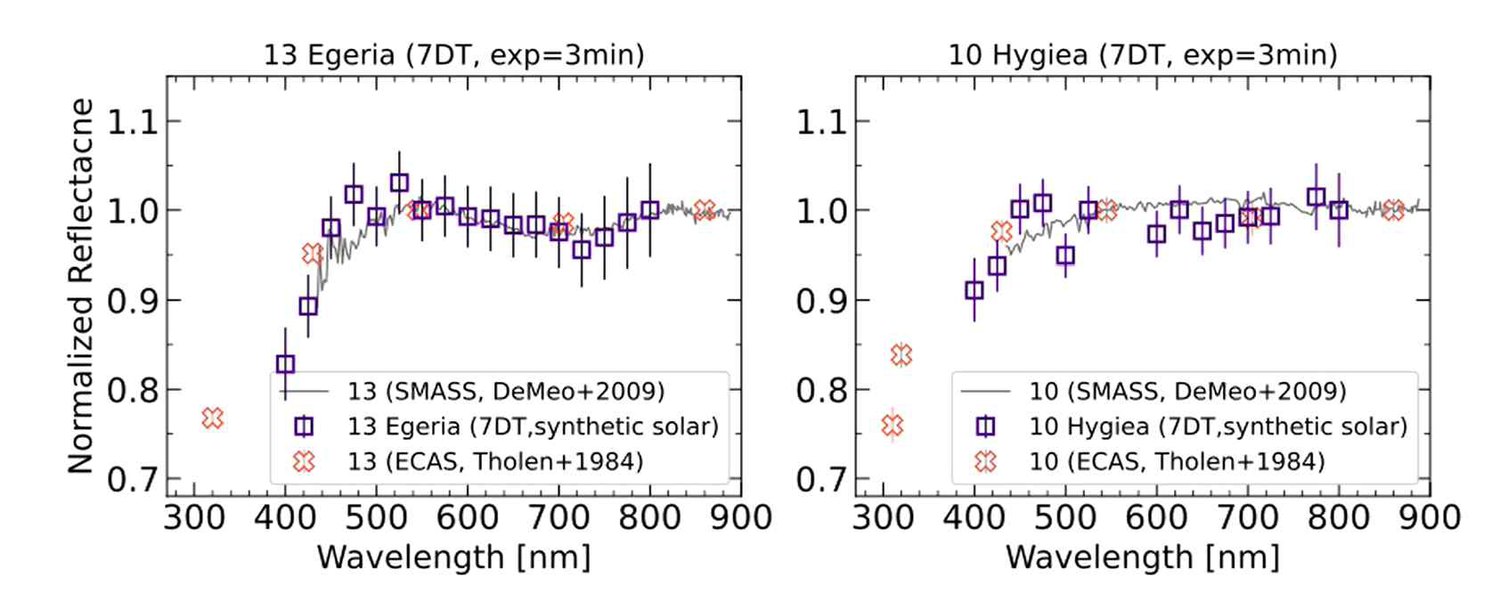
Medium-band imaging of the main-belt asteroids 13 Egeria and 10 Hygiea targets the 0.7 µm absorption feature characteristic of Ch-type bodies, a tracer of their thermal history. Time-series observations of the third interstellar object, 3I/ATLAS, followed the emergence of extended CN emission as it fell inside 3 au — behavior resembling that of 2I/Borisov at comparable heliocentric distance.
What it looks like
What the program aims to deliver
- Reflectance spectra for roughly 100,000 solar system objects, against about 3,000 classified spectroscopically today
These are program targets over the seven years of the survey, not results in hand. What has been observed so far is on the status page, and published work is listed under publications.