publicationJul. 2026
7DT Insight: Variability in Young Stellar Objects
Kim, M.-R. et al.
Center for the Gravitational-wave Universe · Seoul National University
A medium-band survey of the southern sky, measuring a low-resolution spectrum for every source it observes and repeating the measurement over time. It is carried out with the 7-Dimensional Telescope, an array of twenty 50-cm telescopes in Chile.
The 7-Dimensional Sky Survey (7DS) is a medium-band survey of the southern sky. It is carried out with the 7-Dimensional Telescope (7DT), an array of twenty 50-cm telescopes at El Sauce Observatory in Chile, built and operated by the Center for the Gravitational-wave Universe at Seoul National University. Each unit carries a share of a forty-filter medium-band set, so a single visit records a low-resolution spectrum of every source in 1.25 square degrees. As of now, sixteen units and thirty-five filters are in routine operation.

A medium-band spectral energy distribution for every source in the field supports a wide range of science from one data product: how galaxies assemble and cease forming stars, where the heavy elements are produced, the expansion rate of the Universe, accretion onto black holes, the variability of young stars, and the composition of small solar-system bodies. 7DS was designed to identify gravitational-wave counterparts; the same images serve the rest.
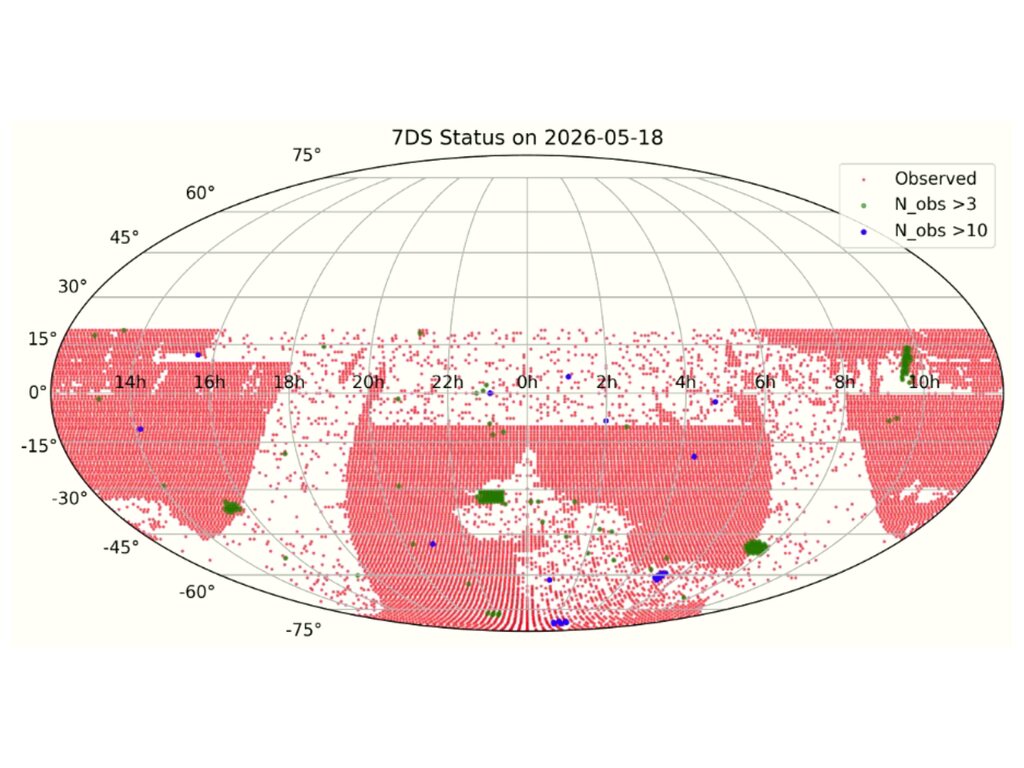
7DS comprises three surveys that trade area against depth and cadence: a single-visit reference map of the southern sky, a time-domain survey on a 10-14 day cadence, and nightly monitoring of a deep field at the south ecliptic pole. All three use the same tiling of the sky, so their data coadd directly.
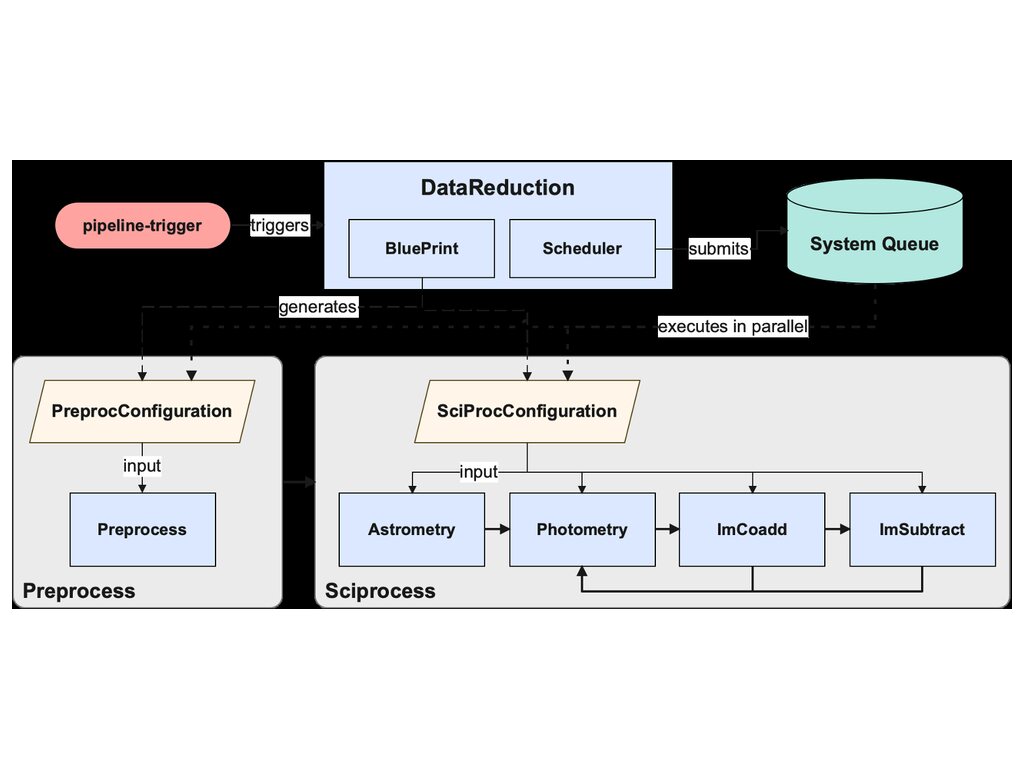
Twenty DeltaRho 500 units on direct-drive mounts, sixteen currently observing, one control computer per operational telescope, a scheduler that can interrupt the night and begin a follow-up exposure in under a minute, and a pipeline that reduces a 3,000-image night the same day. The array is built to observe a transient while it is still bright.