Motivation
7DS measures two things a conventional survey does not measure together: the spectrum of every source in the field, and how that spectrum changes with time.
A spectrum for every source in the field
Two capabilities define what 7DS can answer. The first is spectral mapping: every visit samples the spectrum of every source in the field at R = 30-70 across 375 to 875 nm. That is coarse compared with a spectrograph, but it resolves the 4000 Angstrom break, strong emission lines and broad continuum features, and it applies to every object in 1.25 square degrees at once rather than to the few that fit on a slit.
The practical consequence is that classification does not depend on follow-up. A source detected in a 7DS image already carries the information needed to estimate a photometric redshift, separate a quasar from a star, or distinguish a kilonova from the supernovae and detector artifacts that outnumber it — at the moment of detection, for every object in 1.25 square degrees. The filter set that makes this possible, and which bands exist on a given tile, are described under status and overview.
Repeating the measurement
The second is the time domain. Because the spectral measurement is made by imaging, it can be repeated: the same field is revisited on cadences from one night to two weeks, so what is measured is not a spectrum but its evolution. Questions that need both at once — what a transient is while it is still bright, how an active galactic nucleus responds to its own variability, how a young star changes from night to night — are the ones this survey is built for.
The three surveys exist to put that repetition at different cadences: one visit everywhere, a revisit every 10 to 14 days over a smaller area, and nightly observation of a single deep field. Which cadence a question needs is what determines which survey serves it — set out under survey design.
What the questions require
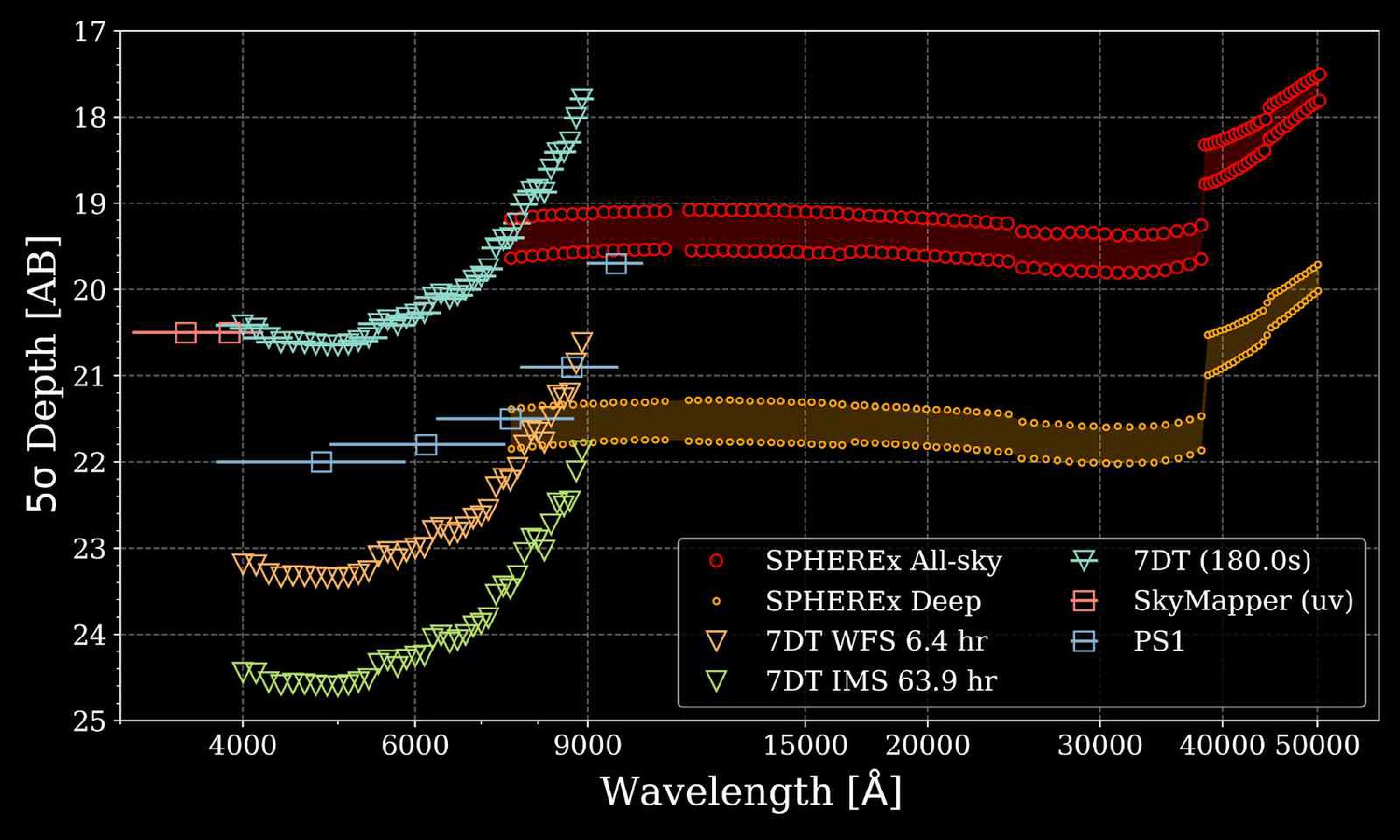
Spectral information is only useful as far out as the survey can detect a source, and the depth reached at each wavelength is what decides which of the questions below are answerable. Sampling the spectrum in many narrow steps costs depth per band relative to a broadband survey of the same aperture, and the survey design trades that against the three cadences.
The comparison below also shows why 7DS and SPHEREx are complementary rather than redundant: they reach similar depth over overlapping wavelengths, but 7DS resolves the sky roughly ten times more finely, so a 7DS pixel is a measurement of one source where a SPHEREx pixel is a blend of several. Measured per-band depths for the current filter set are on the performance page.
Seven science themes
Each theme below draws on the same data product: a medium-band spectral energy distribution for every source in the field, measured repeatedly.
Multi-messenger Astronomy
Where do gravitational-wave events happen?
02Transients
What happens in the first hours of an explosion?
03Galaxy Formation & Evolution
How do galaxies build themselves, and where are the ones we have never seen?
04Cosmology & Photometric Redshifts
What is the universe made of, and why do the two measurements of its expansion disagree?
05Active Galactic Nuclei
How did supermassive black holes grow so large so early?
06Galactic Science & Exoplanets
What is our Galaxy made of, and what is in the atmospheres of its planets?
07Solar System Objects
What were the building blocks of the Solar System made of?