Galaxy Formation & Evolution
How do galaxies build themselves, and where are the ones we have never seen?
Why it matters
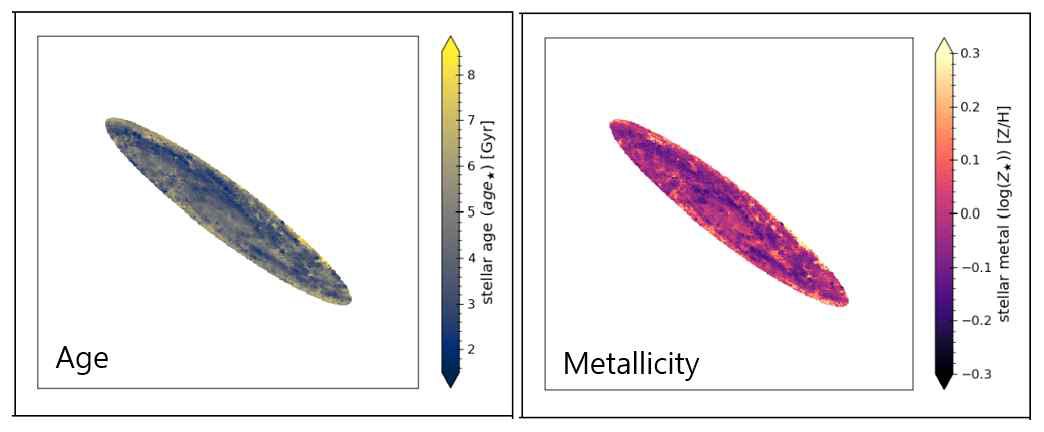
Every pixel of a 7DT image carries a low-resolution spectrum, which makes a nearby galaxy an integral-field observation rather than a photometric one. Emission lines can be isolated from the stellar continuum band by band, and the stellar populations behind that continuum can be fitted pixel by pixel — age and metallicity as maps rather than as single numbers per galaxy.
At the other end of the scale, the same data address a gap in every existing redshift map. Behind the plane of the Milky Way, crowding and dust have left a zone of avoidance where few galaxies are cataloged at all. Because 7DS measures a spectrum for every source rather than a color for every source, galaxies and quasars can be picked out of those crowded fields.
What 7DS contributes
Medium-band mapping over 1.25 square degrees is IFU-like data at survey scale. Star-forming clumps are identified through Hα emission in stellar-continuum-subtracted images, and pilot studies indicate that pixel-based SED fitting of 7DT and SPHEREx data can recover spatially resolved stellar populations approaching the quality of high-resolution IFU spectroscopy — for galaxies that would otherwise demand dedicated campaigns on much larger telescopes. Both studies are as yet unpublished (Shim et al., submitted; Lee et al., in prep).
What it looks like
![NGC 253 in the 7DT m625, m650 and m675 medium bands, and the resulting continuum-subtracted H-alpha plus [N II] emission map](/img/science/ngc253-halpha.jpg)
What the program aims to deliver
- 50 million galaxy spectra, forming a southern-sky catalog
- 2 million galaxies with spatially resolved spectra
- 5 million galaxies and 20,000 quasars recovered in the zone of avoidance
- More than 100,000 clusters and superclusters mapped out to redshift 1
These are program targets over the seven years of the survey, not results in hand. What has been observed so far is on the status page, and published work is listed under publications.