Galactic Science & Exoplanets
What is our Galaxy made of, and what is in the atmospheres of its planets?
Why it matters
Surveys of the Galactic plane usually trade one thing for another: either many stars measured crudely, or few stars measured well. Sampling the spectrum of every pixel removes the trade — stars, H II regions and planetary nebulae in the same field are all measured the same way, and diffuse structure gets a spectrum per pixel rather than a single integrated color.
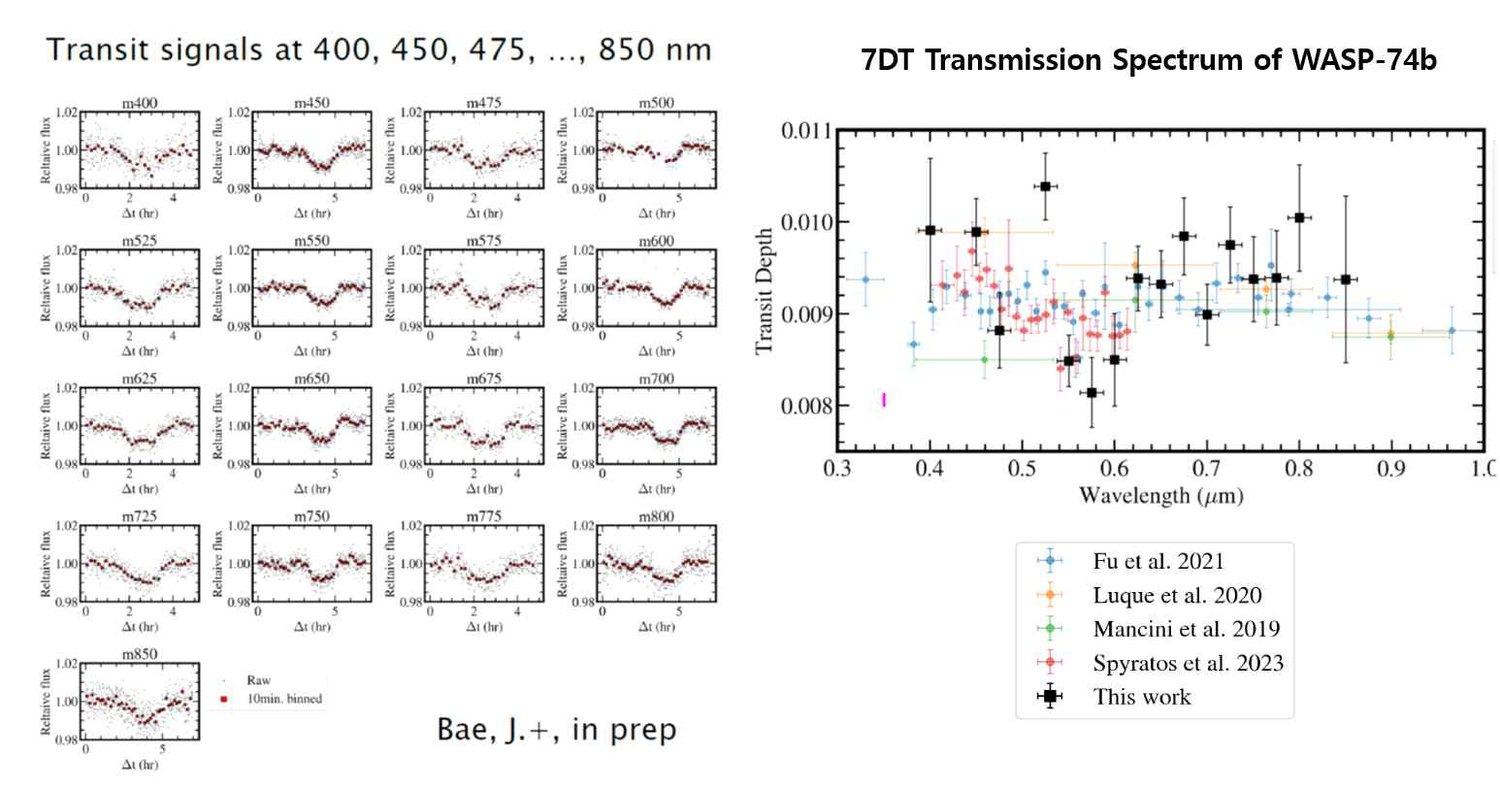
Transiting planets benefit from the same property for a different reason. Measuring a transit simultaneously in every band gives the transit depth as a function of wavelength in one visit, from a single telescope, without the systematic errors that come from stitching together transits observed on different nights.
What 7DS contributes
Two-epoch 7DT photometry with sixteen medium bands across 400–825 nm identified 110 variable young stellar objects in the central region of Orion A — 14 percent of 769 candidates — including seven varying by more than 0.5 mag. The wavelength dependence of the variability distinguishes extinction-like, gray and spot-like mechanisms on day timescales, which otherwise requires rapid filter cycling or simultaneous multi-band instrumentation. The same combination of cadence and spectral sampling applies to transiting exoplanets: a transit observed in many bands at once measures its depth as a function of wavelength, which separates a genuine planetary signal from a blended eclipsing binary and constrains stellar activity that would otherwise bias the derived planet radius.
What it looks like
What the program aims to deliver
- Spectra for roughly 100 million stars, constraining the origin of the Milky Way's stellar populations
- Transmission spectra for transiting exoplanets, measured in all bands within a single transit
These are program targets over the seven years of the survey, not results in hand. What has been observed so far is on the status page, and published work is listed under publications.