The 7DT array
An array of twenty commercial 50-cm telescopes, operated as a single instrument. Off-the-shelf optics kept it inexpensive and quick to bring on line; the filter set is what makes it unusual.
One instrument in twenty parts
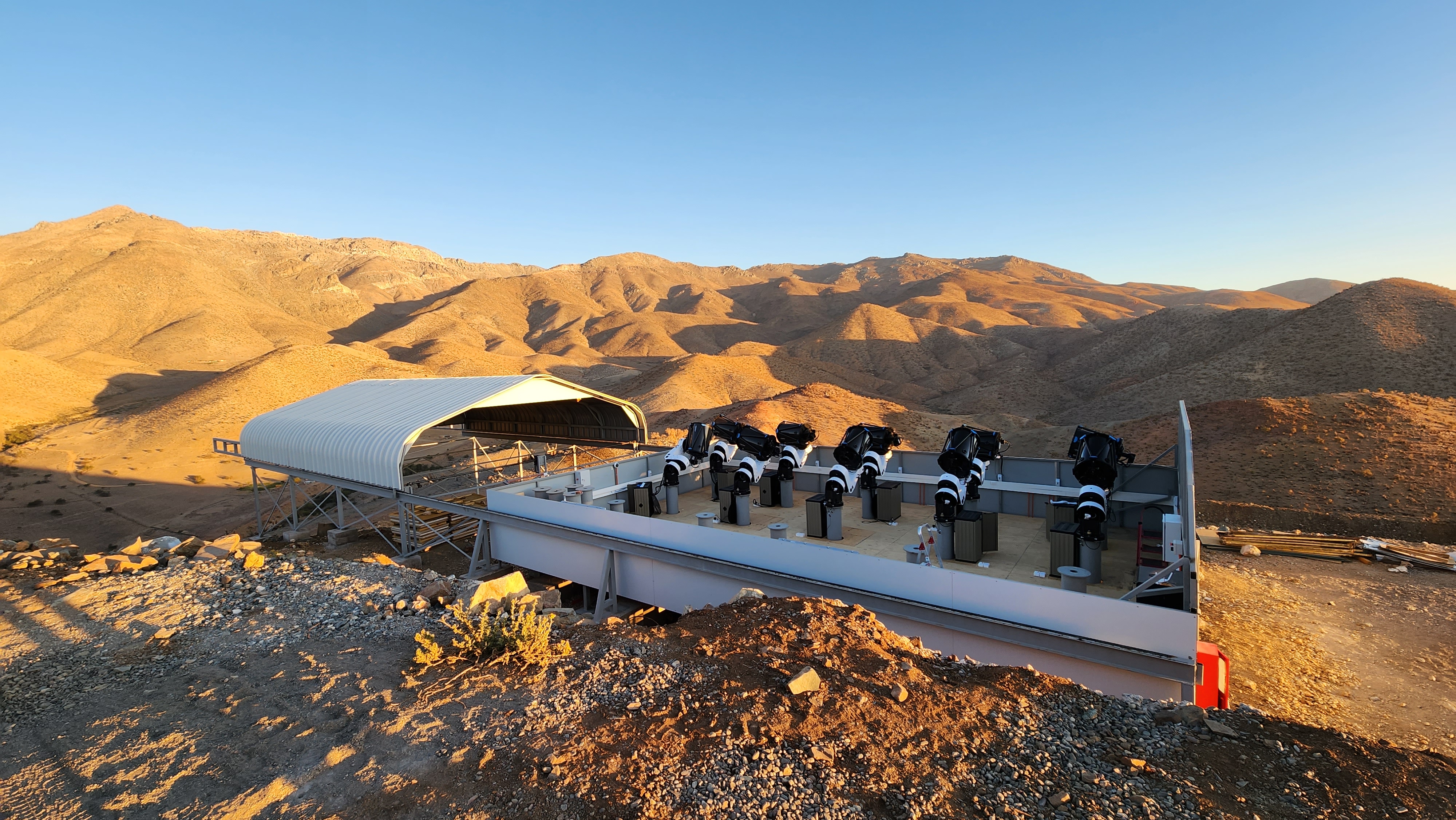
7DT is an array of twenty 50-cm commercial off-the-shelf telescopes. Each unit is a PlaneWave DeltaRho 500 optical tube assembly on an L-500 direct-drive mount operated in equatorial configuration, paired with a Moravian Instruments C3-61000 PRO CMOS camera — every unit identical but for the filters it carries. Sixteen of the twenty are deployed and operational as of June 2026, and the four remaining units complete the array. All operational units share a common configuration and show consistent optical performance in routine use.
Across the sixteen operational units the point-spread function measured at field center on good nights ranges from 1.4 to 2.2 arcseconds FWHM, with an array median of 2.0 arcseconds closely tracking the median site seeing. Unit-to-unit scatter in delivered FWHM is 0.2 arcseconds, and the PSF grows by 0.3 arcseconds from field center to corner while ellipticity stays below 0.1 over the central 80 percent of the field. The array behaves as a coherent set of instruments rather than sixteen independent telescopes. Median delivered FWHM has held stable to within 0.3 arcseconds since routine survey operations began in July 2024.
As measured on sky
For the canonical 100-second exposure the 5-sigma point-source depth reaches 19.06 mag in the bluest medium band (m400) and 16.60 mag at the longest wavelength (m875), peaking at 19.61 mag in m475 near maximum system throughput. The Sloan broad bands reach 20.59, 20.25 and 19.17 mag in g, r and i. These are nominal-condition figures: seeing better than 2.0 arcseconds, airmass below 1.5, and non-bright nights.
| m400 (bluest medium band) | 19.06 mag |
|---|---|
| m475 (peak throughput) | 19.61 mag |
| m875 (reddest medium band) | 16.60 mag |
| Sloan g | 20.59 mag |
| Sloan r | 20.25 mag |
| Sloan i | 19.17 mag |
System summary
| Array | |
|---|---|
| Telescopes in the array | 20 |
| Currently operational | 16 (as of June 2026) |
| Field of view per pointing | ≈ 1.25 deg² |
| Spectral resolution | R = 30–70 |
| Unit telescope | |
| OTA | PlaneWave DeltaRho 500 |
| Optical design | Corrected Cassegrain |
| Primary diameter | 50.8 cm |
| Focal length | 1537 mm |
| Focal ratio | f/3.0 |
| Image circle | 70 mm (≈ 2.6°) |
| Mount | PlaneWave L-500, direct drive |
| Mount slew rate | 20 deg s⁻¹ |
| Camera & filters | |
| Camera | Moravian C3-61000 PRO |
| Sensor | SONY IMX455 back-illuminated CMOS |
| Sensor size | 36 × 24 mm |
| Sensor dimension | 9576 × 6388 pixels |
| Pixel size | 3.76 µm |
| Pixel scale | 0.5 arcsec |
| Field of view per unit | 1.34° × 0.90° |
| Filter wheel | 9 slots per unit |
| Broad bands | Sloan u, g, r, i, z |
| Medium-band filters (design) | 40 |
| Medium-band filters installed | 35 (as of June 2026) |
| Wavelength coverage | 375–875 nm |
| Medium-band FWHM | 14–41 nm (typ. 25–30) |
| Site | |
| Observatory | El Sauce, Río Hurtado Valley, Chile |
| Coordinates | 30°28′16″ S, 70°45′47″ W |
| Altitude | 1600 m |
| Median seeing | ≈ 1.5 arcsec |
| Clear nights | > 300 per year |
| Zenith sky brightness | 21.97 mag arcsec⁻² |
| Computing & storage | |
| Processing server | Proton — 2 × AMD EPYC 7513 |
| CPU / memory | 128 cores @ 2.6 GHz / 512 GB |
| GPU | 2 × NVIDIA A100, 82 GB (NVLink) |
| Storage | Lyman 2 × 1.2 PB, Balmer 1.2 PB |
| Total capacity | ≈ 3.6 PB |
| Data link | KREONET, GridFTP ≈ 80 MB s⁻¹ |