Multi-messenger Astronomy
Where do gravitational-wave events happen?
Why it matters
GW170817 remains the only gravitational-wave event whose kilonova was identified, and the reasons are structural rather than accidental. Localizations span hundreds to thousands of square degrees. The kilonova itself is faint and fades within about a day. And searching an area that large turns up thousands to tens of thousands of unrelated transients and artifacts, any of which can pass for the real thing in broadband imaging.
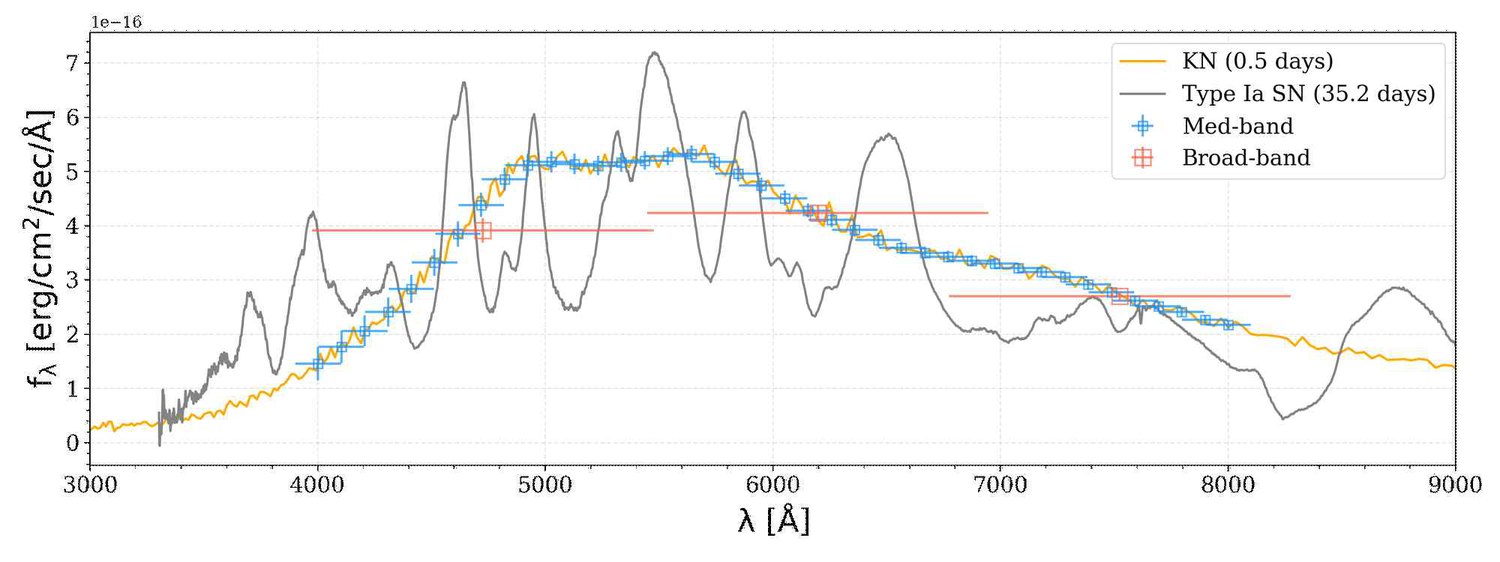
The conventional response is a sequence: localize, image wide, build a candidate list, then chase candidates with spectroscopy on a larger telescope. The spectroscopy is the bottleneck, and it arrives after the source has faded. 7DT collapses the sequence by imaging and spectrally sampling at the same time, so every candidate arrives already carrying the information needed to keep or reject it.
What 7DS contributes
The application 7DT was designed for. A kilonova peaks near absolute magnitude −15 to −17 and fades by roughly half a magnitude per day, within a gravitational-wave localization of hundreds to thousands of square degrees; a single 100 deg² region is expected to contain of order a hundred unrelated transients over a seven-day window. 7DT addresses this with wide-field tiling, sub-minute response to an alert, and sufficient spectral information in one visit to reject contaminants without follow-up spectroscopy.
What it looks like
What the program aims to deliver
- Optical counterparts for gravitational-wave events, with the statistical properties of their host galaxies
- About ten kilonova-bearing events — enough to decide the Hubble tension by standard-siren distances
These are program targets over the seven years of the survey, not results in hand. What has been observed so far is on the status page, and published work is listed under publications.